
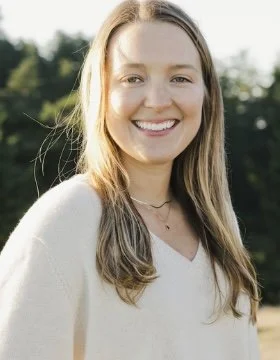
Annie Pederson
Research Fellow, Boston University
Can you describe the research you’re working on as part of TIME-AD?
As part of TIME-AD, I am working on Project 2, examining the relationship between depressive symptoms and cognitive outcomes using various g-methods to control for time-varying confounding, as well as exploring the relationship between depressive symptoms and ADRD biomarkers. In addition to this work, I also contribute to the Cognition, Exposures, and Covariates (CEC) core, where I help lead efforts to harmonize exposures and covariates across datasets and develop a Qualtrics survey to facilitate crosswalking between measures, allowing us to more accurately compare findings across datasets and support triangulation.
What’s been the most exciting or rewarding aspect of your research to date?
The most rewarding part has honestly been the people! Getting to collaborate with and learn from so many brilliant researchers is something I didn’t fully anticipate. There’s something really motivating about working to answer questions that everyone around you genuinely cares about, because we all want to move the needle on public health.
If you could change one thing about how research is done or communicated, what would it be?
I wish more people would challenge the idea that a single study is enough to draw conclusions. No one study can tell the full story, which is why we work so hard to replicate findings and use different approaches to triangulate!
What do you enjoy doing outside of work?
Outside of work, I love spending time outdoors. Whether that’s going on walks around the neighborhood, long bike rides, or cold plunging in the ocean. It’s where I feel happiest and most inspired!
What drew you to science in the first place?
I’ve always been curious. I have been fascinated by genetics and wanting to understand how things work at that level. What really drew me to science is that it gives you a framework to ask questions and pursue answers in a rigorous way.
If you weren’t a scientist, what do you think you’d be doing?
Honestly, I think I’d still end up in science, but if I weren’t in epidemiology, I’d probably be a wildlife biologist!
What’s a book, podcast, or movie you’ve loved recently?
I listen to The Daily every day. It’s a great way to stay informed and I like how it breaks down topics in a digestible way.